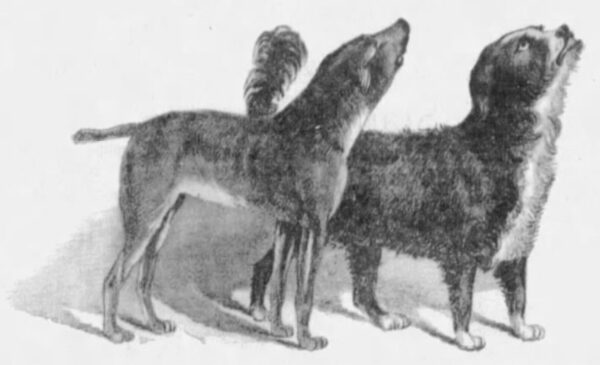
Bummer and Lazarus: Gold Rush Dogs Who Became Legends
San Francisco has a long history of what some might call heartwarming quirkiness. One story I’ve always loved involves two stray dogs that became mascots of San Francisco during the raucous era known as the Gold Rush.
I’m talking, or course, about Bummer and Lazarus, the infamous street dogs of San Francisco.
Bummer, a shaggy black-and-white Newfoundland mix, first appeared in downtown San Francisco around 1860. He was brought to town by a newspaper reporter who had relocated from Petaluma.
At the time, cities were overrun with stray dogs, often at a rate of two dogs for every single human. Most were killed with poison to thin the herd, but unfortunately, mutts were not the only thing rampant in the cities. Rats were a plague and if you were a good ratter, you were a dog that just might survive.
Bummer proved himself to be a remarkably efficient rat-catcher, so while other dogs were rounded up by dog catchers or poisoned, Bummer always remained. He became a fixture outside Martin’s Saloon at Montgomery and Washington Streets, where scraps and affection were freely given.
Eventually, he connected with Lazarus, a stray who was severely injured in a dog fight. Left with a deep wound in his leg, Lazarus likely would’ve met his final destination were it not for Bummer who dragged him to safety, kept him warm and brought him scraps of food until he fully healed.
Once recovered, the new found companion was given the name Lazarus, a dog arisen from the dead. From that moment on, Bummer and Lazarus were never apart. It also helped tremendously that Lazarus was almost a better ratter than Bummer. Legend has it that together they killed 86 rats just over one lunch.
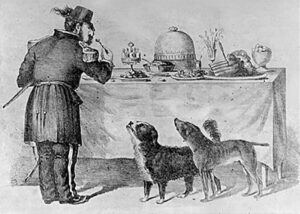
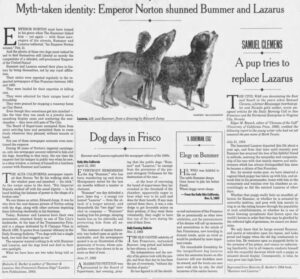
Bummer and Lazarus roamed the streets of San Francisco freely and gained such celebrity, that even Mark Twain, who was a frequent visitor of San Francisco, drew cartoons about them in his home state of Virginia, under his real name of Samuel Clemens. Personas were created, with Bummer as the suave gentleman, and Lazarus the sly opportunist. Their antics — chasing cats, stealing food, getting into scraps with rival dogs — were chronicled with the same flair as political news in the Daily Alta California, the Daily Morning Call and the Evening Morning Call. They were often seen in the presence of Emperor Norton, a beloved and eccentric figure in the City, whom I will write about later.
City Ordinance
After a serious lapse in judgment, when Lazarus got picked up by a dog catcher, so fearful was the populace that Bummer and Lazarus at any time might be rounded up and euthanized, a city ordinance was passed declaring them public dogs, protected from harm or capture.
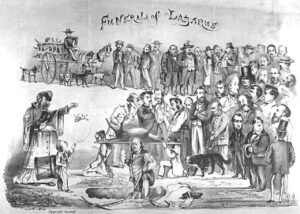
But sadly, a dog’s life is short, especially back then, and Lazarus met his fate in 1863 allegedly after being poisoned. An obituary was posted in the papers along with a public funeral.
Bummer lived another year or so, and at one point picked up a small puppy as a companion, but after getting kicked down a flight of stairs by a drunk, he took a turn for the worse and died a few weeks later in 1864. (Read Mark Twain’s eulogy.)
Never forgotten
Both dogs were stuffed and displayed for a time in Martin’s Museum on Market Street, but their whereabouts are now lost to time. (As a side note, the taxidermist left a lot to be desired.)

While Bummer and Lazarus might be departed, their place in history is secure.
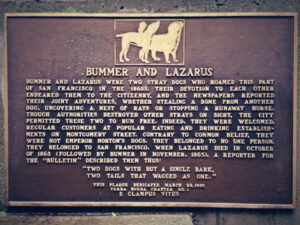
A bronze plaque noting their legendary exploits stands in front of the Transamerica Pyramid Building at Montgomery and Washington, the former site of their previous haunt, Martin’s Saloon. So late at night, if walking by the pyramid you hear the faint howl of a lone dog, maybe give a tip of the hat. Because you just never know.
For a pre-release discount on The Haunting that Ended the Summer of Love, I invite you to sign the reminder form on this page.
Comments (0)