San Francisco’s Ghost Cable Car: Are You a Believer?
Here’s a ghost story to chew on, not seen by a lot of people, but seen by enough to raise the spectre of the supernatural.
Nob Hill is one of the ritzier areas in the City, known for its collection of high-end hotels, including The Fairmont Hotel, The Mark Hopkins, and The Stanford Court. Rumor has it that on especially foggy nights, a vintage cable car— not a current style, but one representative of the early 1900s— is seen gliding through the mist, replete with a full cargo of passengers, all dressed in turn-of-the-century attire. Even through the fog, witnesses claim a look of terror is etched on their faces. But turn your head for a second or blink a little too long and the cable car is gone.
Adding to this disorienting apparition, the faded red cable car exists in eerie silence, emitting a faint, flickering light as it glides down California Street or maybe Jackson Street, perhaps towards Chinatown and even, sometimes, making its journey along streets with no tracks at all.
One constant is that the ghost car shows up almost to the day of the worst cable car tragedy in San Francisco—May 7th to be exact.
May 7, 1926, a day of infamy
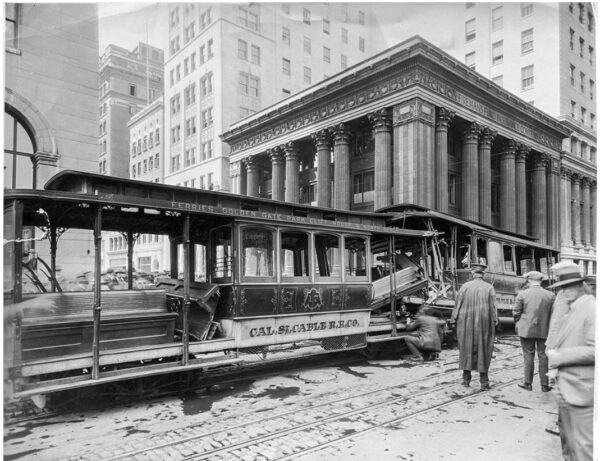
In 1926 that spring day started as just another routine journey. A cloudburst had opened the skies, as is often the case in San Francisco, just as a bushel of people packed onto the cable car to head to work. Imagine, if you will, these fairly new cable cars, with limited safety features and wonky brakes, chugging up and down the dangerously steep hills of San Francisco. Add to that rainy days and wet pavement, and you’ve created a recipe for disaster. And it wasn’t just one cable car accident. The City was replete accidents— brakes failing and cable cars rolling backwards down streets and through intersections.
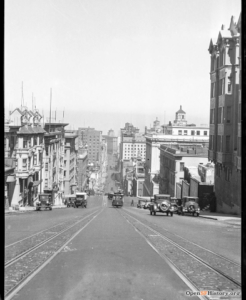
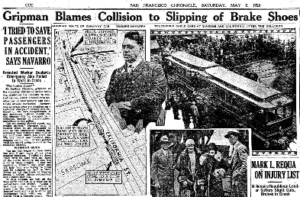
But the calamity on this day would prove to be like no other. Just as the cable car was passing the Fairmont Hotel and beginning it’s downward trek to the Ferry Building, a survivor recalls hearing the grip man mutter,“These brakes. These brakes.”
An instant later, those words made sense. Packed to the gills, the car started careening down the rails. At Stockton Street, “the car shot forward and seemed to almost sail through the air.” In a panic, passengers started jumping off, then two cars were side-swiped, followed by the cable car leaping “through the intersection of Grant Street.” (Source SF Chronicle)
At Kearny Street, an automobile was in the targets and after being hit spun like a top through the window of a tailor shop. A second later the cable car hit a large truck that pivoted and smashed through the window of a restaurant. Adding insult to injury, the truck was carrying meat byproducts, including intestines and organs to be made into beef tallow, all of which landed on top of everyone in the cable car.
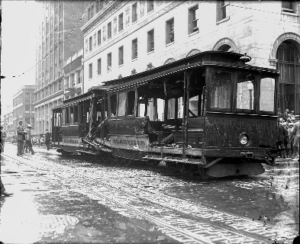
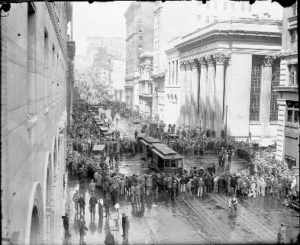
It didn’t stop there. At Montgomery Street, another cable car that had momentarily stopped was suddenly in the line of fire. That conductor, seeing the runaway cable car bearing down, yelled for everyone to jump right before the two cars sliced into each other in a meld of twisted metal. The juggernaut could not be stopped and the two cars, now join together, continued to Sansome and California Streets before finally wailing to a halt.
When one considers the trajectory, it’s not totally unreasonable that an energy imprint might embed. Hundreds were injured, with some passengers trapped in the mangled steel, while the entire route of the runway cable car was strewn with bloody passengers.
In the end, three people died. It was the worst accident in San Francisco cable car history.
(As a side note, while the conductor of the runaway cable car was initially praised for his calm, cool head, a scapegoat was needed, and the next day he was accused of negligence by the California Street Cable Railroad Company. The company also stated it “was willing to pay hospital bills, unless demands were exorbitant.”)
So how does this fit with the ghost cable car documented throughout the years?
There are many theories. One is that the ghost cable car represents the 1926 crash with its terrified passengers frozen in time, reliving their horror over and over. Another suggestion is that the ghost cable car is a larger energy imprint, encompassing all of the cable cars accidents, of which there were many. It was indeed a dangerous time.
So what do you think? Does the ghost cable car exist? Or is it a figment of an overactive imagination?
For a pre-release discount on The Haunting that Ended the Summer of Love, I invite you to sign the reminder form on this page.
Comments (0)